Rossotti's Alpine Inn History in Portola Valley
August 13, 2026
August 13, 2026
During the 2019 renovation of Rossotti's Alpine Inn, construction crews pulled up old wood paneling and found a name carved into it that predated the work by sixty-seven years. The carving belonged to a Stanford freshman who had been on campus for about five minutes before his roommate told him to drop his bags and head up the hill for a pitcher of beer. That freshman's son, restaurant veteran Greg St. Claire, was the one overseeing the renovation when the carving turned up.
Most people in Portola Valley just call the building Zott's, and the sign out front still advertises it as the second oldest continually operating tavern in California. What that sign doesn't say is how much work went into keeping that claim true. The tavern has operated under at least eight different names since 1852, changed hands more than half a dozen times, and came within one family's decision of closing for good in 2018. The building's continuity was chosen, not inherited, and the choosing happened recently enough that the people who made it are still behind the bar.
The property's first chapter starts with Felix Buelna, a former mayor of San Jose, who built a roadhouse in 1852 at the crossing of the old Arrastradero trail to Mission Santa Clara and what became Alpine Road. As KQED reported, local historian Nancy Lund said the origin of the tavern likely came down to "a gift or a wager," and Buelna's own grandson believes his grandfather lost the property in a rigged poker game at the Searsville Saloon. By 1868, the land had passed to William Stanton. Whatever actually happened at that card table, it set a pattern the building has followed ever since: ownership changing hands faster than the building's purpose ever did.
Local historians and the current owners tend to trace the same rough sequence, even if some of the exact transition dates have blurred over 170 years:
Some of the Prohibition-era stories are impossible to pin down. Writer Virginia Bacon, in her account for Portola Valley, Past and Present, described the bootlegging legends as varied and unverifiable. What the current owners can confirm is more concrete: a basement beneath the tavern, reached by a hatch, was used to store liquor during Prohibition, and there is evidence rooms were once rented out by the hour. The building earned historic landmark status in 1969 and was added to the National Register of Historic Places in 1973, formalizing what regulars had already assumed for over a century.
The most surprising chapter in the building's history has nothing to do with drinking. On August 27, 1976, researchers from Stanford Research Institute parked a van next to the tavern, then known as Rossotti's, carried a computer terminal into the beer garden, and set it down on a picnic table. They wired the terminal to the van, and a researcher named Nicki Geannacopulos typed a progress report that traveled through a packet radio network to ARPANET and on to a terminal in Boston. It is considered one of the first three-network transmissions in what would become the internet, the moment that gave the word its meaning: not one network, but several joined together.
The researchers didn't choose the spot for its burgers. The location sat close to a hilltop repeater station and wasn't far from SRI's own offices in Menlo Park, which made it a convenient link in the signal path. The tavern was simply in the way of something much larger, which turns out to be a fairly accurate description of its whole history. Things kept happening at this address that had very little to do with what the building was actually selling.
The Alexander family had owned the tavern for decades when Molly Alexander died at 93. Her family made the decision to sell, and for a while it wasn't clear what would happen to the property next. What ultimately saved it was a group of longtime customers rather than an outside investor. Deke and Lori Hunter, Fred and Stephanie Harman, and Jim Kohlberg, three local families who had been coming to the tavern for years, bought the property and brought in St. Claire, whose Avenir Restaurant Group also runs Nola in Palo Alto, Milagros in Redwood City, and Town in San Carlos. The group reopened the tavern in August 2019 after six months of construction.
| Kept | Changed |
|---|---|
| The Zott's burger name | Beef now sourced from St. Claire's own cattle ranch in Loma Rica or grass-fed Oregon beef |
| Reclaimed barn wood floors | Vegetables organic and local, including heirloom tomatoes from Webb Ranch |
| Redwood tabletops milled from a La Honda water tank | A wood-fired pizza oven, built into a 1942 Dodge farm truck |
| Historic photographs and carved tabletops on display | A large smoker brought in to handle a limited kitchen |
| The creekside beer garden along Los Trancos Creek | QR-code ordering and compostable serviceware, since there wasn't room for a commercial dishwasher |
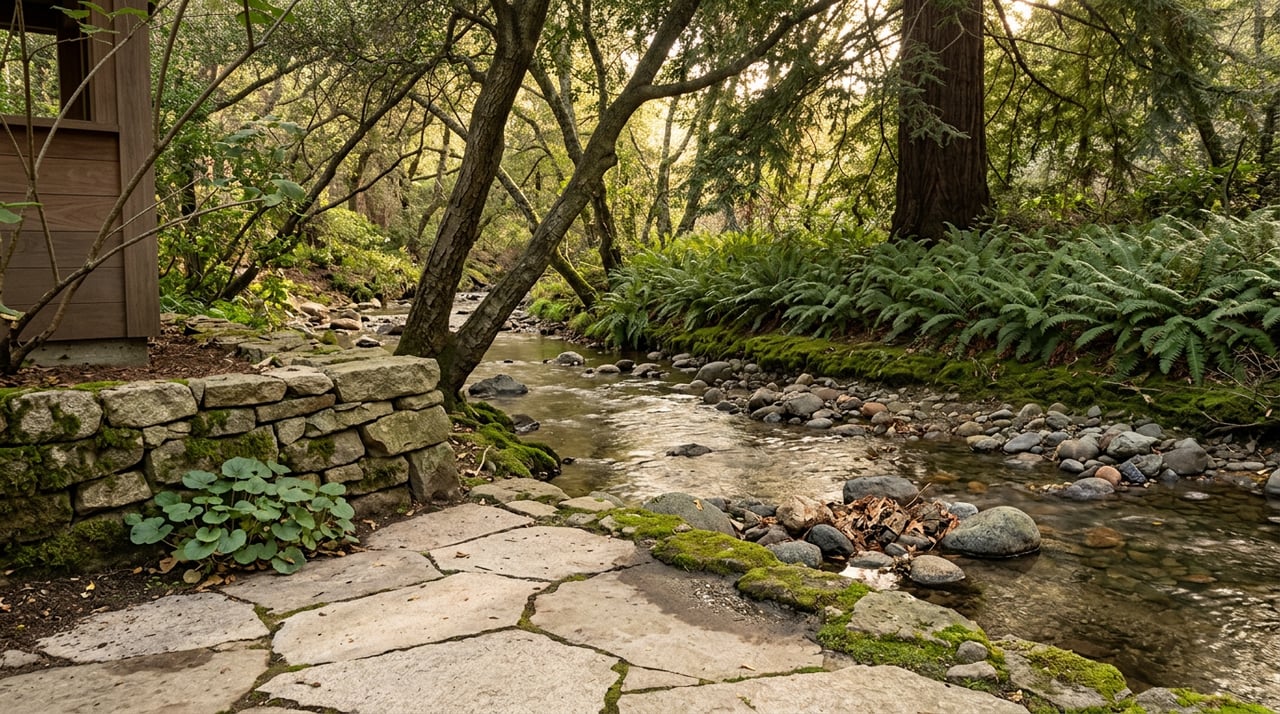
The distinction matters more than it looks. The renovation kept historic features while addressing practical issues: a kitchen too small for the crowds, a creek hidden behind an old fence and a moldy shack. Clearing that fence opened up a view of Los Trancos Creek and expanded the outdoor capacity to around 300 people, according to KQED's reporting on the reopening.
Rossotti's Alpine Inn sits at 3915 Alpine Road, closed on Mondays, open Tuesday through Thursday from 11:30 a.m. to 9 p.m., Friday until 9:30 p.m., and weekends from mid-morning through early evening. The current menu runs through wood-fired pizzas like the Besio, topped with spicy fennel sausage, mascarpone, Calabrian chili, and a honey drizzle, alongside St. Louis pork ribs smoked for eight hours with a choice of Carolina gold, Texas bold, or Kansas bourbon sauce, plus smoked chicken and pulled carnitas tacos. Ordering still happens by QR code at the table, a detail that gets mixed reviews from longtime regulars but hasn't slowed down a Friday night crowd.
Portola Valley has been called Roadhouse Valley since long before that was a marketing phrase, back when the word simply described what a roadhouse was for. Rossotti's is the last one still standing on Alpine Road, and it is standing there today because three families decided a building's history was worth the six months of construction it took to keep it going. That is a different story than the one the sign tells, and it is the one worth knowing if you already live here.
If Portola Valley's layered history is part of what drew you to the area in the first place, Bob Kamangar has spent decades getting to know this stretch of the Mid-Peninsula, from its roadhouses to its real estate. Let's Connect.
Stay up to date on the latest real estate trends.
Rooted in trust, expertise, and sincere dedication, Bob brings a lifelong appreciation of what “home” means to every client and every move.