California Avenue in Palo Alto This Summer: What Changed
August 6, 2026
August 6, 2026
If you live within walking distance of California Avenue, you can feel the block operating on a different clock this July than it did two summers ago. The parklets are still there. The Sunday farmers' market still sets up at nine. What has shifted is quieter and more consequential: the City Council spent the spring writing rules that assume the block will stay pedestrian and stay roofed, and the operators signing new leases have priced that assumption into their menus.
The result on a resident's calendar is a week with more built-in reasons to walk over than there used to be, and a tenant mix that has moved away from the sports-bar-plus-fast-casual pattern that used to define this stretch.
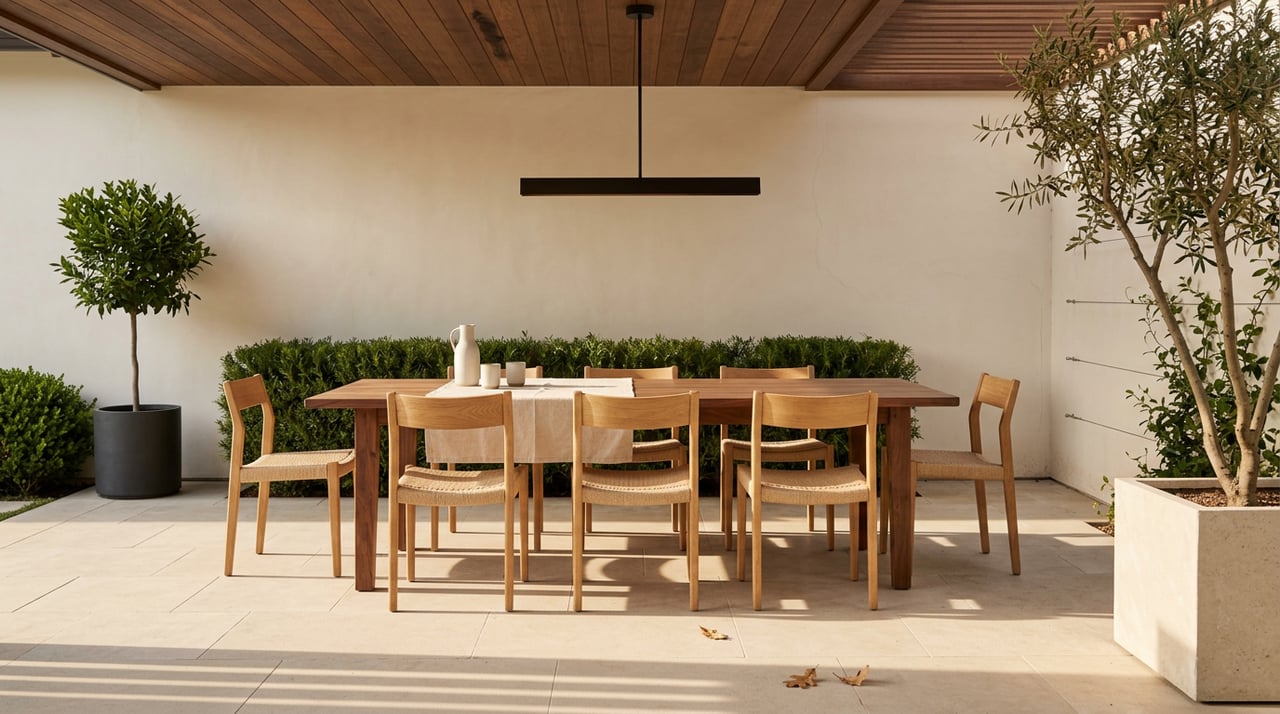
For most of the last three years, the parklets on Cal Ave were operating on borrowed time under interim rules. The design that was originally proposed would have removed the roofed structures in favor of open tables with umbrellas, a version that triggered complaints from restaurant owners that they would not withstand cold and rainy days.
That version died. On June 1, the Council approved new design standards for the car-free stretch between El Camino Real and Birch, offering three models with more weather protection — one a cabana with a sloped roof and overhangs, another a pergola with a flat roof. The bike question was settled in the same round: cyclists can still ride through, but thermoplastic bands along the street function as a traffic-calming texture that encourages them to slow down, a departure from the earlier two-way bike lane concept that merchants worried would encourage speeding.
The practical translation for a resident is simple. A rainy Tuesday in February no longer collapses a Cal Ave dinner reservation into a takeout order. Operators can now furnish, staff, and menu a parklet the way they would an indoor room, because the roof is a permanent fixture rather than a variance waiting to expire.
The clearest way to see the shift is to look at who signed leases while the parklet rules were being finalized. These are not national chains testing a market. They are second and third restaurants from operators already working the Peninsula.
Bistro Demiya, 407 Lytton Avenue. Demi Ebara and Arthur de la Cueva are opening their sixth Bay Area restaurant this summer in downtown Palo Alto, an elevated version of their casual chain Demiya, which specializes in Japanese curry. The space seats about 25, with an additional 10 in the backyard, which is a scale that only pencils out when the outdoor seats stay usable through the shoulder seasons.
La Corneta Taqueria, 324 University Avenue. The 31-year-old taqueria's fifth restaurant replaced SliderBar on University Avenue, with co-owner David Perez-Campos targeting an opening before Cinco de Mayo. Weekday and Saturday service running to 10 p.m. gives the block a late-casual option that Cal Ave itself does not really have.
Rikyu, former TOMO Tea House space. The team behind Los Altos omakase restaurant Hiroshi is opening a matcha cafe in the former TOMO Tea House footprint, adding matcha and coffee beverages with housemade syrups alongside Japanese sandos including katsu-style chicken and A5 wagyu.
The Rendezvous, 195 Page Mill Road. Fans of the old Cal Ave bistro Pastis, which closed in 2022, can again find the escargot, mussels, and pâté at a new French-Italian bistro and wine bar on Page Mill, opened by Menlo Park restaurateur Giuseppe Carrubba, owner of Kirk's Steakburgers, Caffe Riace, and Osteria Toscana, and chef Maxime Roucoule, whose earlier kitchens included Joanie's Cafe, Pastis, and La Boheme. The wine list runs about 300 labels, roughly 40% French, 30% Californian, and 30% Italian.
Croissanté, 321 California Avenue. The French bakery, with outposts in Santa Clara and Los Gatos, is taking over the former Antonio's Nut House space, with owner Sean Kang expecting a late 2026 opening after a significant delay.
The pattern is worth sitting with. Every one of these operators already had at least one Peninsula location before signing here. They are not testing whether Cal Ave will support a serious kitchen. They are compounding what they already know.
The block has always had anchors. What summer 2026 added is spacing between them.
The point is not the count of new places. It is that the week now has a shape a resident can actually follow, with predictable programming on Thursdays and Sundays and enough dinner rooms in between to rotate through without repetition.
There is a version of this story that treats Cal Ave as a food court with a parklet problem. That version misses what the operators are saying with their leases. As Bevri owner Pavel Sirotin put it to a Bay Area News Group reporter walking the parklets in the spring, "We live in California, where the weather is almost always perfect."
The Council seems to have come around to the same reading. Vice Mayor Greer Stone, a longtime parklet advocate, told the same reporter that through community engagement with residents, customers, and businesses, the city had found a middle ground he expected to activate Palo Alto in ways it had not seen in the past. There is also a proposal in play to allow open alcohol beverage containers within the closed-to-cars areas on California Avenue and Ramona Street for special events, which could be in effect as early as this summer if the Council signs off.
None of that erases the friction. There is ongoing litigation between downtown property owner Elizabeth Wong and the city over the downtown Coupa parklet on Ramona Street, with Wong seeking more than $600,000 in damages and a nullification of the parklet. The retail-versus-restaurant tension the Wong suit surfaces is the same tension that Cal Ave landlords will keep working through in the next lease cycle.
Two other stories will shape how Cal Ave feels a year from now, and both are worth having on a resident's radar before they hit the headlines.
The first is the new state law. Senate Bill 79 increases the allowable height and density of housing projects that are within the half-mile radius around major public transit stops, such as Caltrain. The Palo Alto City Council voted on June 15 to carve out exemptions for historic properties and cap height and density standards at half of what is otherwise allowed under the law, but the local restrictions did not take effect until July 16, leaving a two-week window during which SB 79 held sway. In that window, nine project developers proposed 384 new homes within half a mile of either the downtown or Cal Ave. Caltrain stations. Most of those sites sit within a short walk of the parklets.
The second is the 156 California Avenue proposal from Redco Development, a mixed-use housing project that the city has since floated multiple design options for. If either that project or the smaller 414 California proposal moves through review, the character of a two-hour Sunday on the block will change again, this time because of what is being built above the storefronts rather than in front of them.
The 2026 Bicycle and Pedestrian Master Plan the Council approved on June 15 also matters here. The plan calls for separated bikeways, enhanced school routes, and pedestrian amenities at dozens of intersections over the next decade, with broad goals to improve safety at car-heavy thoroughfares like San Antonio and Middlefield and further enhance popular bike routes like Maybell Avenue and Bryant Streets. Cal Ave's own bike treatment sits inside that framework now, which is part of why the thermoplastic-band decision landed the way it did.
Read the parklet vote and the tenant announcements together, not separately. The block is not being reinvented, and it is not decaying. It is being incrementally rewritten by operators who have watched the pedestrian conversion hold for four years and decided the roof rules were the last piece of certainty they needed. That is a slower story than a grand-opening headline, but for a resident planning a Thursday concert, a Sunday market run, and a Friday dinner reservation, it is the story that matters.
If you own a home nearby and want to talk through how the coming construction cycle and the shifting tenant mix on Cal Ave and University will read against your specific block, Bob Kamangar is happy to sit down for that conversation. Let's Connect.
Stay up to date on the latest real estate trends.
Rooted in trust, expertise, and sincere dedication, Bob brings a lifelong appreciation of what “home” means to every client and every move.